
 Our places
  Chowder Bay


Behind the walls of Biloela Industrial School
Sarah Auburn (recorded in newspapers as Orbin) first came to public attention in 1869 when Rupert Worthington was charged with her abduction. At the time, Sarah was documented as a 13-year-old living with her family near Goulburn, where her father worked as a goldminer. During the court proceedings, Sarah stated that she had gone with Worthington willingly and that she feared violence from her parents. Worthington was found guilty and served two years’ of hard labour at Darlinghurst Gaol. Sarah was subsequently sent to the Newcastle Industrial School. In 1871, the girls from the Newcastle Industrial School were transferred to a new location at the former gaol on Cockatoo Island. The island, along with the Industrial School, was renamed Biloela in an effort to distance it from the stigma associated with Cockatoo Island’s prison past.
Shortly after arriving at the Biloela Industrial School in 1871, Sarah and seven other girls were charged with breaking windows at the school. Newspapers reported the behaviour of the girls as riotous, with stones and bricks being hurled flying in all directions and about 100 panes of glass being broken. Following their arrest and transfer onto the water police boat, the girls reportedly began singing and “continued to exercise their vocal powers up to Circular Quay”. The girls gave evidence that they had acted with provocation after being placed in a dormitory with nothing but bare flagstones. All the girls, except Sarah, pleaded guilty. Despite her pleas, Sarah was sentenced to pay £3 in default or serve two months imprisonment with hard labour. Unable to pay the fine, she served the prison term. She was about 15 years old at the time
After her release, Sarah was returned to Biloela but didn’t stay out of trouble long. In June 1872, she and three other girls from Biloela rioted, smashing 30 panes of glass in the schoolroom. The girls were brought before the court, though there are no details of her punishment. A report dated 19 June 1872 by George Lucas, Superintendent of the Biloela reformatory, noted that the girls had been confined to a dormitory and placed on a diet of bread and water for ten days as punishment. In August 1872, Lucas recorded that seven girls were involved in an attempted arson, alleging that Sarah had supplied the matches. As a result, Sarah was placed in a straitjacket for half an hour until she became passive and obedient. Later that month, Sarah was released from Biloela. Her discharge warrant listed her age as 18, though she was most likely only 16. The warrant was issued under the name Mary White which was the alias she had used when apprehended in Goulburn in 1869.
Between the streets and the court
In 1880, Sarah married Joseph Navaon, an Italian immigrant, at St Matthias Anglican Church in Paddington and became known as Sarah Nava. The couple went on to have five sons.
In 1896, Sarah and an acquaintance named Frances Howell were charged with assault. It was alleged the women, described as newsvendors, match sellers and ‘sisters’ by the press, had attacked a rival during a dispute over trade sites, and that Sarah – “a thorough nuisance” – had delivered a “blow in the mouth”. The ‘sisters’ were fined 20 shillings each or 21 days imprisonment.
In 1899, Sarah’s 15½-year-old son, Joseph, was arrested for possessing goods suspected of being stolen. In Central Court, Sarah – by now a widow – gave evidence that she earned a living by selling newspapers. She explained that her son often slept away from home and despite having a good home, refused to stay there. As a result of his defiance, she requested that he be sent to an Industrial School. Joseph was subsequently sent to the Carpentarian Reformatory for Boys for a two-year term.
In 1901, Sarah found herself in trouble with the law again when she was charged with obstructing a footpath while selling newspapers and sent to Darlinghurst Prison. The following year, Sarah appeared in court once more. She was fined 1 shilling, with 5 shillings and 6 pence in costs, for allowing a child under ten years of age to sell newspapers.
Life at the newsstand
Although newspaper reports continue to cover the activities of Sarah’s sons from this time, and note an incident in 1911 where Sarah witnessed an assault near her newspaper stand at Tooth’s Brewery on Broadway, she does not reappear in the public record until 1932. That year, The Sun featured a story and photograph of Sarah, noting that her age had been exaggerated and describing her as selling newspapers, cigarettes and tobacco “from dawn till dark” at her stand on the corner of George and Park for 45 years. Over the following years, further articles highlighted her long-running newspaper stand. In 1936, she appeared in newspaper and magazine advertisements endorsing Junipah Mineral Spring Salts.
In 1939, newspapers reported that Sarah had paid her first visit to the pictures. She was quoted as saying that the film Beau Geste was fine but didn’t think she would repeat the experience as “it might become a habit.” In the article, Sarah recounted growing up on the goldfields outside Goulburn and working with a pick and shovel as a child. She also mentioned that she was unable to read or write but was interested in the news and had someone read the newspaper to her at night.
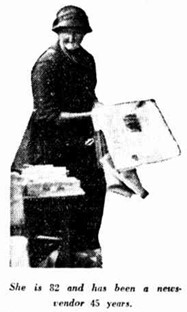
Image credit: The Sun, Sunday 7 February 1932, page 2.
The enduring legacy of Sarah Nava
When Sarah Nava died in 1943, reportedly aged 97, The Sun described her life in Sydney, noting that she had arrived in the city at age 15 and begun selling ice creams and soft drinks outside Randwick Racecourse. The Goulburn Evening Post reported that she had continued working at her newspaper stand until about a year prior to her death.
It is unsurprising that Sarah was able to reinvent herself after her release from the Biloela Industrial School. Girls sent to Biloela often came from homes in difficult situations. Of Sarah’s siblings, one sister was also sent to Biloela, two brothers were sent to the Vernon Industrial School ship and a further two sisters appear in records for attending the Benevolent Society. Sarah’s father appears to have died around 1873 and her mother, who married young, later relocated to Sydney. Sarah had committed no crime when she was sent to Biloela. She was simply a victim of poverty.
Although officially listed as a widow, it is likely that Sarah’s husband abandoned the marriage, as no death records for him can be located. It is also clear that Sarah significantly raised her age, for unknown reasons, possibly to assist with the publicity she was receiving for her newsstand and her endorsement of the Mineral Spring Salts. Four months after her death, the Newcastle Sun reported that her son, David, appeared before the Registrar in Bankruptcy. David, who had taken over Sarah’s newsstand, was recorded as 44 years old, meaning Sarah would have been 53 at the time of his birth.
Sarah left a lasting legacy on the City of Sydney, as a symbol of resilience and triumph over adversity. Rising from poverty, she became a successful businesswoman, with her newsstand reportedly generating over £2,000 a year in 1932 – a significant sum at the time. Over a decade after her death, newspapers continued to remember her as “the most colourful of newsvendors,” describing her as “a weather-beaten figure in black… a black straw bonnet crowning her authority and making her territory sacrosanct.”
References
- Australian Star, Thursday 24 December 1896, page 5
- Balone Beacon, Thursday 9 February 1933, page 14.
- Daily Telegraph, Tuesday 11 February 1902, page 8.
- Daily Telegraph, Wednesday 3 October 1917, page 5.
- Evening News, Thursday 24 December 1896, page 6.
- Evening News, Thursday 24 August 1899, page 4.
- Express and Telegraph, Saturday 29 August 1908, page 1
- Goulburn Evening Post, Monday 11 January 1943, page 3
- New South Wales Police Gazette and Weekly Records of Crime, Wednesday 22 November 1882, Issue No 47, page 46. Deserting Wives and Families, &c.
- Newcastle Sun, Friday 21 May 1943, page 3.
- Sun, Sunday 7 February, 1932, page 2.
- Sun, Saturday 18 November 1939, page 3
- Sun, Monday 11 January 1943, page 3
- Sun, Thursday 11 March 1954, page 33.
- Sydney Morning Herald, Friday 9 July 1869, page 3
- Sydney Morning Herald, Wednesday 4 April, 1883, page 11
- The Newcastle Industrial School for Girls, The AUBURN Sisters - The Newcastle Industrial School for Girls
- The Truth, Sunday 31 December 1911.
Article was originally published on 16 March 2026 and written by Volunteer Researcher, Michele Harper.
