
 Our places
  Chowder Bay


As part of the National Trust’s Australian Heritage Festival in New South Wales, join us for a public screening at Middle Head / Gubbuh Gubbuh, including a guided walk with military historian Brad Manera. Book your ticket here.
A landscape of tents and training
The ground was covered with rows of white tents, forming regular streets across the encampment.
– Australian Town and Country Journal, 5 April 1890
Today, Middle Head / Gubbuh Gubbuh is a landscape shaped by many layers of history: from ongoing First Nations connections to Country, to its role in coastal defence and eventual return to public land.
Bushland paths wind past former military buildings and sweeping harbour views. Yet long before these were built, the headland was already a place of military activity.
During the late 1800s, Middle Head / Gubbuh Gubbuh became the site of the Easter Encampments – large temporary military camps that transformed the headland each year into a bustling landscape of tents, drills and spectators.
From imperial defence to colonial responsibility
For decades the British garrison guarded the Australian colonies. Coastal fortifications were built at locations including Dawes Point and the 1801 fort on Middle Head / Gubbuh Gubbuh, monitoring ships entering the harbour. In 1870, British garrisons were withdrawn as part of wider imperial reforms. Maintaining distant garrisons was costly and Britain increasingly expected the colonies to organise their own defence. Its attention was focused on India and Africa. At the same time, imperial rivalries, particularly with Russia, raised fears that ports such as Sydney could be attacked.
The withdrawal of the British garrison meant that the colonies were for the first time responsible for defending their own shores.
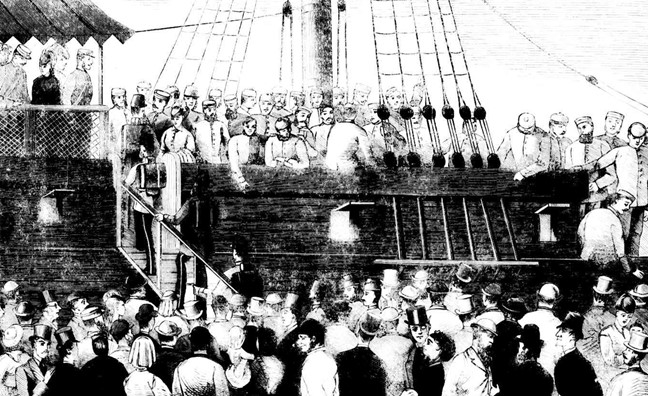
Image: Departure of troops from NSW, Illustrated Sydney News, 6 September 1870, NLA 18365329
The shift prompted reform. Sydney Harbour was central to the colony’s defence and Middle Head / Gubbuh Gubbuh held a strategic position overlooking the harbour entrance. Alongside Georges and Bradley’s Head, South Head and North Head, it formed part of a wider defence network. New and more powerful gun batteries and defensive works were built throughout the late 1800s into the early 1900s, aimed at defending the harbour approach.
Colonial governments began developing their own defence forces, combining small permanent infantry and mounted units with a growing network of volunteer soldiers. These volunteers were ordinary citizens who, when not working at their civilian jobs, trained in roles such as gunners, engineers and signallers.
A temporary military town
Each year, the Easter Encampments brought these forces together for training. Held over the Easter holiday period, the encampments typically lasted around a week, with volunteers travelling from across New South Wales to gather at locations around Sydney. One of the most important locations was Middle Head / Gubbuh Gubbuh, where surrounding fortifications and proximity to the harbour provided an ideal setting for training and large-scale events.
Rows of canvas tents stretched across the plateau, with parade grounds and drill areas between them. Life followed a strict routine of military drills and inspections. For soldiers, the encampments offered a rare experience of what life would be like during active service.
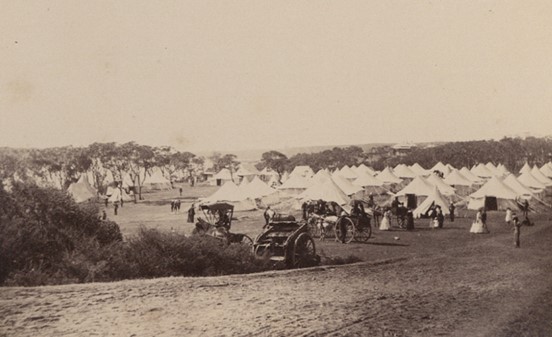
Image: Volunteer Camp, 1886 – Middle Head, T Hewitt, from the album 'Works by Members of the Amateur Photographic Society of N.S.W presented by the Society to His Excellency Lord Carrington August 1886', Private collection: Graham Trevena
Defence as public spectacle
The Easter Encampments were not simply military exercises – they were also major public spectacles held across the headland and harbour.
Visitors travelled to Middle Head / Gubbuh Gubbuh to observe the camps, wandering through the tents as volunteer soldiers drilled. The week would culminate in large-scale mock battles across the headland and harbour, described by contemporary newspapers not only as training exercises, but also:
‘for the entertainment of the visitors’.
– Australian Town and Country Journal, 11 April 1891
Spectators gathered along the ridgelines to watch mock battles and demonstrations of new defence technologies. These displays reassured the public that the colony could defend its shore.
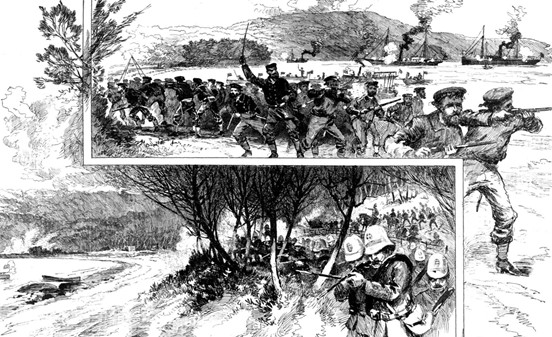
Image: Easter Military Manoeuvres, in Australian Town and Country Journal, 14 Apr 1888, NLA 18373666
A place of training and participation
The Easter Encampments reveal an important dimension of Middle Head / Gubbuh Gubbuh’s history. Here, within a temporary city of tents, drills and spectators, volunteers from across New South Wales stepped away from everyday life to train and take part in a growing system of local defence.
Sources and further reading:
- Gilchrist, C., & Manera, Brad. The Easter Submarine Mine Disaster, Sydney 1891.
- Grey, Jeffrey. A Military History of Australia. Cambridge: Cambridge University Press, 1999.
- Nicholls, Bob. The Colonial Volunteers: The Defence Forces of the Australian Colonies 1836–1901. Sydney: Allen & Unwin, 1988.
- Oppenheim, Peter. The Fragile Forts: The Fixed Defences of Sydney Harbour 1788–1963. Sydney: Kangaroo Press, 1988.
- Wilcox, Craig. For Hearths and Homes: Citizen Soldiering in Australia 1854–1945. Sydney: Allen & Unwin, 1998.
- Australian Town and Country Journal, 5 April 1890 and 11 April 1891.
