


 Subscribe
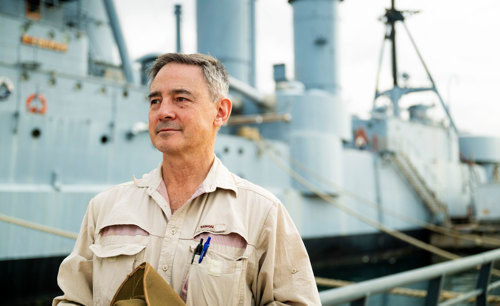
Can you share a bit about your career journey and how you came to join the Harbour Trust?
The destinations under the stewardship of the Sydney Harbour Federation Trust have layered histories with links to Australia’s military, social and industrial history as well as the ubiquitous connection to the lives of First Nations peoples past and present.
I was selected to join the Harbour Trust because of my background in the interpretation of military sites.
I replaced a very gallant veteran of wars in Iraq and Afghanistan, Colonel Garth Callender, when he moved to Queensland.
Today I am the senior historian and curator at the Anzac Memorial in Hyde Park, Sydney.
My museum career spans half a century from a high school volunteer at the Army Museum of Western Australia to the first travelling curator of the Western Australian Museum’s Local Museums Programme, a foundation curator in Social History at the National Museum of Australia, historian at the Australian War Memorial and head curator at the Hyde Park Barracks Museum. I am also an affiliate in the History Department at the University of Sydney.
I publish regularly on the website of the Anzac Memorial, in history journals and at conferences. Having curated more than a dozen exhibitions at the memorial, I also lead tours of battlefields on which Australians have fought and bled.
My recent publications include In That Rich Earth (2020) and The Battle of Lone Pine; One Australian’s War (2015), and I compiled the report for NSW Government NSW in the Great War in 2010, coauthored New South Wales and the Great War (2016) and was principal author of Ninety Treasures 90 years; Anzac Memorial 1934-2024 (2024).
I have contributed to documentaries including The Battle of Crete (2020), Painting Gallipoli (2015) The Power of Ten; ANZAC VCs (2015) Waler; The Great Australian Warhorse (2014) Gallipoli: The Frontline Experience (2004) as well as a range of podcasts and televised interviews by the Australian War Memorial, a range of news and current affairs programs and even celebrity genealogy television.
I narrate the annual Sydney ANZAC Day March and most recently I have worked with the Harbour Trust staff to produce 3 short films about the colonial military Easter Encampments that were held on Harbour Trust land at Middle Head / Gubbuh Gubbuh. I have also recently worked on a documentary about a group of artists I took to Greece to create an exhibition that recognises 85 years since the doomed campaign against the Nazi invasion of the Balkans.
What did you study or train and how does this influence your role as a Member of the Trust?
My undergraduate degree is from The University of Western Australia and subsequent studies through the WA Maritime Museum and University of Canberra.
Are there any books, films or experiences that significantly influenced how you think about heritage and public spaces?
It has been my privilege to introduce visitors to public places of great heritage significance.
Leading tours of historic sites around Australia and overseas has given me an intense appreciation of how important a sense of place is. In the centenary extension to the Anzac Memorial, I commissioned the gathering of soil from 100 battlefields on which people from NSW served and surrounded the hall with soil samples from the towns from which they enlisted. I had hoped that it would be a contemplated space but could not have imagined just how intense the response for our visitors would be. It is very rewarding to view the reactions to that rich earth and the significance and meaning people invest in it.
What has been the most defining moment of your career so far?
I have had a very fortunate life and experienced many career highlights. A recent and very special experience was my role as the historian responsible for the retrospective award of the Victoria Cross for Australia to teenage Ordinary Seaman ‘Teddy’ Sheean who had been killed in action in 1942. The reaction by young Australian sailors in the 21st century to what I had achieved, in finding the evidence that convinced Buckingham Palace to grant the award, is one of the most gratifying experiences of my career. It was the first award of the Victoria Cross to a member of the RAN. It was granted 78 years after Sheean’s act of valour.
What is your vision for the future of the Harbour Trust and its destinations?
Our world famous harbour is this port city’s signature. Now that the Harbour Trust is a permanent body with a clear mission, I hope to assist in raising the profile and accessibility of the Harbour Trust and its destinations locally, nationally and internationally.
The destinations managed by the Harbour Trust occupy spectacular locations with remarkable vistas and layered, deep histories. I hope that one day each will be self-sustaining.
Ideally we can maintain each, or at least most, of the destinations the Harbour Trust is presently stewards of and have the ability to provide subtle but appropriate interpretation to inform and enrich the visitor experience.
Is there a lesser-known spot at a Harbour Trust destination that holds personal meaning to you?
I cannot help but pause in the remains of the Military Guard House on Cockatoo Island / Wareamah. The rusty hooks sticking out of the walls show where soldiers of the garrison from the 99th Regiment hung their few personal belongings in 1849.
We are aware and are developing a growing empathy with the convicts who populated our early settlement history but of the soldiers who, having suffered the privations and terrors of the first land wars in New Zealand, little is known. Their names are lost to a handful of surviving nominal rolls but they were as incarcerated as the convicts they were sent to guard.
Which recent project or initiative by the Harbour Trust are you most proud of and why?
I have been delighted with the quality of the interpretation of the military Easter Encampments on Middle Head / Gubbuh Gubbuh in the late 19th century that the Harbour Trust has funded over the past couple of months. They reveal a past that very few know about and recent evidence has suggested that the local population has developed a new and very different appreciation of why the site needs to be opened up. The project has achieved its aims admirably.
What upcoming Harbour Trust project or initiative are you most excited about?
I am very keen to see the completed restoration of the cranes on Cockatoo Island as they are such a powerful reminder of the dockyard and military industrial complex that once played such a significant role in the history of this harbour city.
What role does tourism play in what the Harbour Trust sets out to do?
I believe that tourism is essential to raising awareness and emphasising the significance of sites to the local population and to governments, local and national.
If tourism can generate funds directly that is a bonus but creating accessible and carefully managed sites that tourists want to visit will inevitably have an indirect financial benefit.
What advice would you give someone to start a career in heritage management or conservation today?
Be aware that the emotional and intellectual rewards will always outweigh the financial ones.
The Members of the Trust are non-executive members appointed by the Minister for the Environment and Water. In accordance with the Sydney Harbour Federation Trust Act 2001, this body consists of 8 members including the Chair as well as 2 members recommended by the NSW Government, one representing the interests of First Nations peoples and another who provides a local government perspective and experience. To see the full list of members, click here.
